What if all there is are details? And no big picture? The landscape, when you are out rambling around, is a cascade of little bits of stuff: you take in the scenery in swathes as you’re passing along, maybe with delighted focus on a beautiful, graceful something, or a startled double-check of what might be a stick on the path in front of you, or something more alarming. And along you go, and the little bits of details shove together and pile up and you forget about them after you pass, and all around you, more little bits of stuff (does it all have names?) emerges in glimpses and disappears into the total.
If you’re inclined to worry, it might cross your mind that there’s no way to collect it all; there’s no accountability; there’s no roll call or inventory. There’s no “THE RAMBLING WALK!” that exists in some state of complete thing-ness, with a handy index. AND- about those lovely details? They are always changing. There is no way to get the whole view onto the canvas intact, and even if you pick just a few little things, they are not going to stay the way they are now. You just don’t have a chance of getting it all onto a canvas. Definitely not a whole walk in the woods. No way.
How about an interior? A nice complete painting of a room? Then, at least, you’d be setting limits, wouldn’t you? You have a contained 3-dimensional space and you’re just going to slather it all onto a canvas. Possible? I’m sorry, no. Not even a relatively small interior.
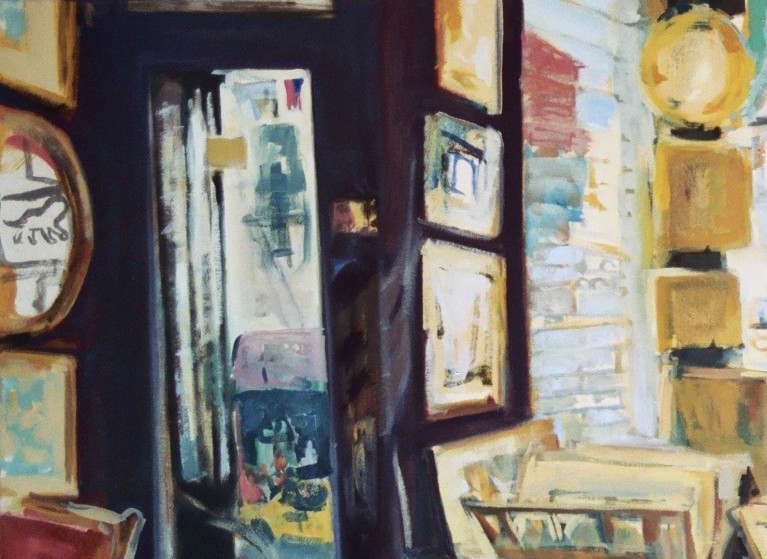
 Details are mysterious little thingies. This is a detail of a painting of the inside of a print shop in NYC that I worked in for a month in the 1990s. I drew the crowded shop walls and the little glimpse of street I could see from the shop desk. See, there’s a reflection of a print of a lion in the mirror on the left-hand wall. Or- is it even possible for someone without a memory of that spot to be able to tell that it’s a reflection of a print of a lion? There’s not much there- it’s more of a hieroglyph that means “this is a reflection of a lion-like picture that must be on the opposite wall of this room.” Details are probably a lot clearer to the artist than to the viewer.
But somehow the little details in a picture have to do with how the whole painting holds together. Details function like “on” switches that the viewer uses to get the painting to come alive. It’s probably part “ok I got that detail” and part “ok I’ll go along with that being a reflection of a lion print that must be on the other side of the room.” It’s part “willing suspension of disbelief,” part “I have no idea what you are asking me to believe”; and occasionally “there is no way I will believe that- but as long as I can just think of it as meaningless little brightly colored squiggles, I will put it on my wall.”
You know that famous picture of Lincoln- you know the one- it was used for a study of how little sensory data we need in order to recognize a subject. How 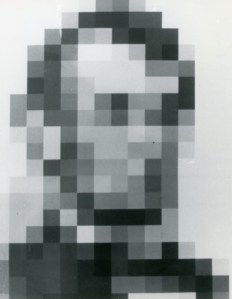 many pixels does it take to say,
“that’s Abraham Lincoln.”?
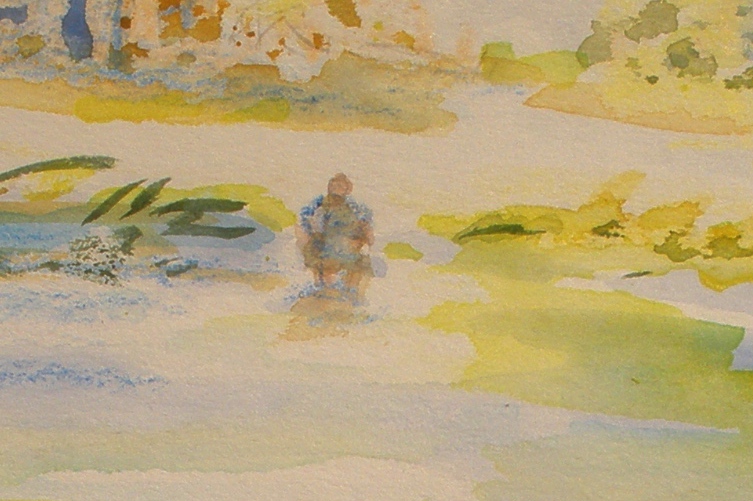
How much of a scribble does it take to say, “that is a woman hoicking up her skirt and wading into water”? This is a little detail in a watercolor and crayon painting, and the figure is about as big as my fingernail. 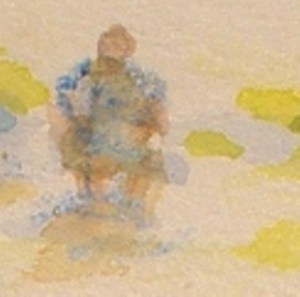
I wasn’t thinking carefully about how to make her look like a woman wading, so the result seems 90% “this is a wading woman because I say so.” Here is the figure in a slightly bigger context.