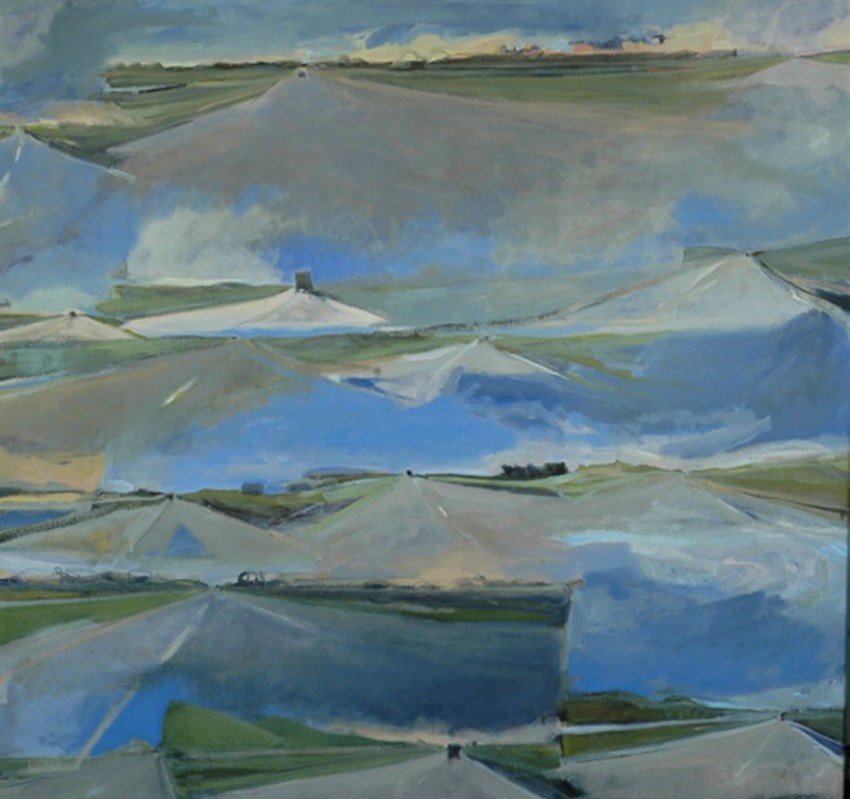
It is hard to get a whole adventure onto a canvas. Paintings are still. They’re outside of time. But there is something compelling about trying to get the sensation of a whole experience within the “time frame” (Pun intended, sorry!) of a canvas. Because you can sit in front of a canvas and consider it. Take your time. A painting is like the best butler in the world. It will hover in front of you silently, offering its view, and you can take details or the whole thing, in any order you want, and there’s no rush. Unlike a movie of “my trip across the country,” which you’d have to start, watch through, and search for bits you want to reconsider- Boring! Oh, the genius arrangement of a painting! It’s all there at once, take what you like, when you like. I bet Steve Jobs admired the brilliant accessibility of paintings.
In 2005 I drove from Connecticut to Bainbridge Island, Washington, with my friend Lori and her son, Julian, and my cat, Goya. On the way, I took a few hundred photos out the windshield. This painting, “Variations on Route 90,” is the result of that adventure. Except- somehow, the familiar Western one-point perspective approach to painting doesn’t quite lend itself to the story of a road trip.
One point perspective is the way that people (and cameras) see the world. We see “now.” And “now” is always, ALWAYS from where your eyes are…now. That may seem obvious, but let me point out a couple of things you might not have noticed: Let’s say you are at the beach. You have, in front of you, lovely ocean going out to the horizon. The horizon line is always at the height of your eye. No, the world is not organizing itself around your eye. Actually, your eye is organizing the world around you. If you climb up on the lifeguard’s tower and look out (do this now) you’ll find that the horizon line has moved up, too. If you lay down in the sand and look out, the horizon will have dropped dramatically, without any of the boats and swimmers out there even being aware of it.
My point is, your view of the world, in every detail, is unique to you at that moment. But- this is not how you really see the world, is it? You’re at the beach: you’re glancing around. Not every object within sight gets full your consideration. You have priorities. Maybe the sailboat is much more interesting than the “no parking” sign. So your focus is shifting. Look around you right now, and notice how little is actually in focus at one time. Cameras can show a lot of the world in focus at once. But our human eyes don’t see that way. We scan around. We’re at work when we look around. And all the time, there’s…time, ticking away. Your “now” is not what the camera, or a one-point perspective painting, shows you. A photograph isn’t a moment that any person ever experienced, really.
“Variations on Route 90” is a collection of painted photo views on one canvas. It has a collage look to it: a nice sense (in my opinion) of being on a freeway out in the country. But it doesn’t break out of one-point perspective.
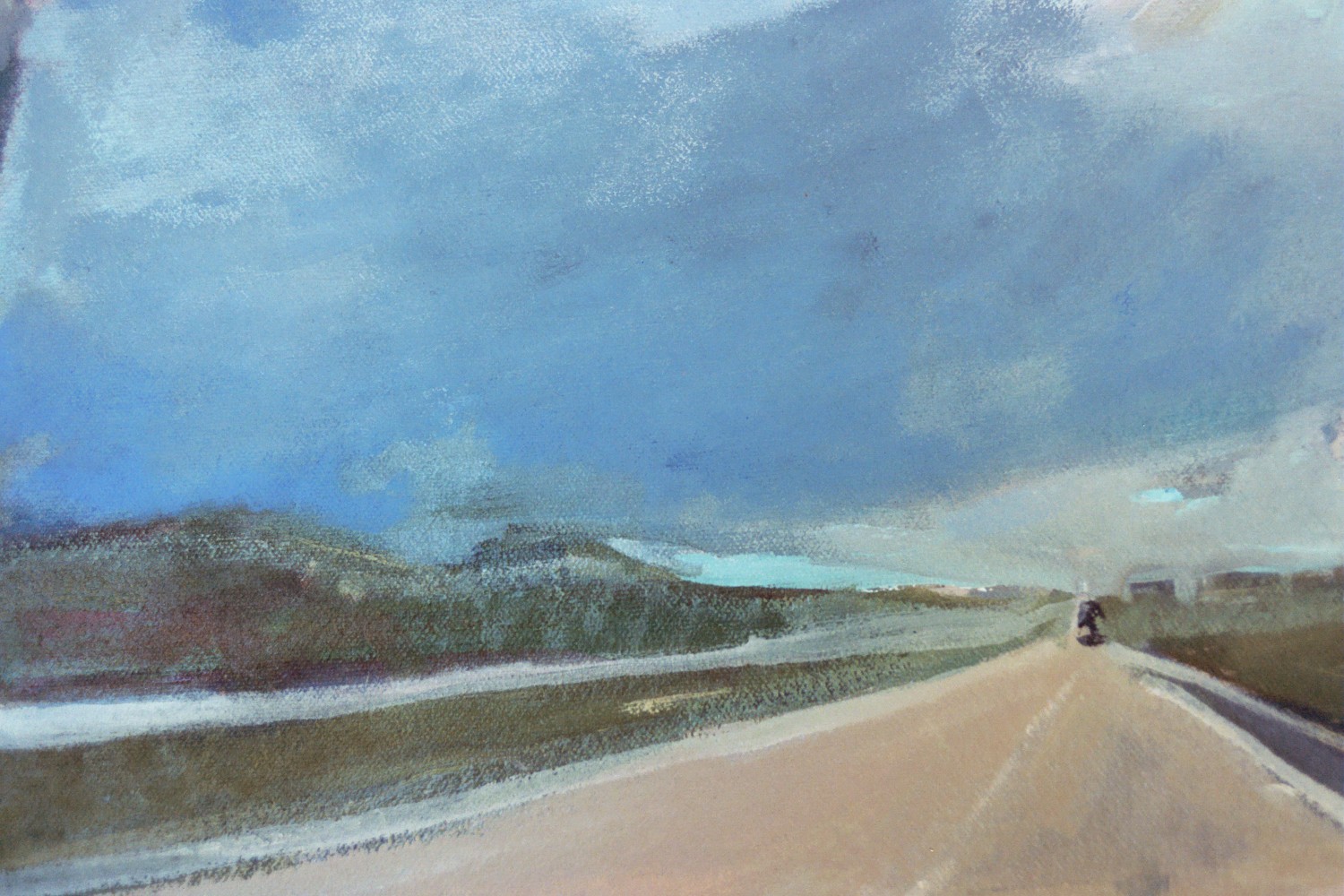 Each little detail in the painting shows the vanishing point on the horizon. The vanishing point is the place, always right in front of your eye, that the world is emerging from. Think of that! If you are on the road to Chicago, the whole city is in that vanishing point. It’s like a dense particle. You can fit everything into that dot on your horizon line. It’s like a very large version of the magician pulling an endless handkerchief out of his fist, the view starting out a thin line in front, and widening and stretching out all around you.
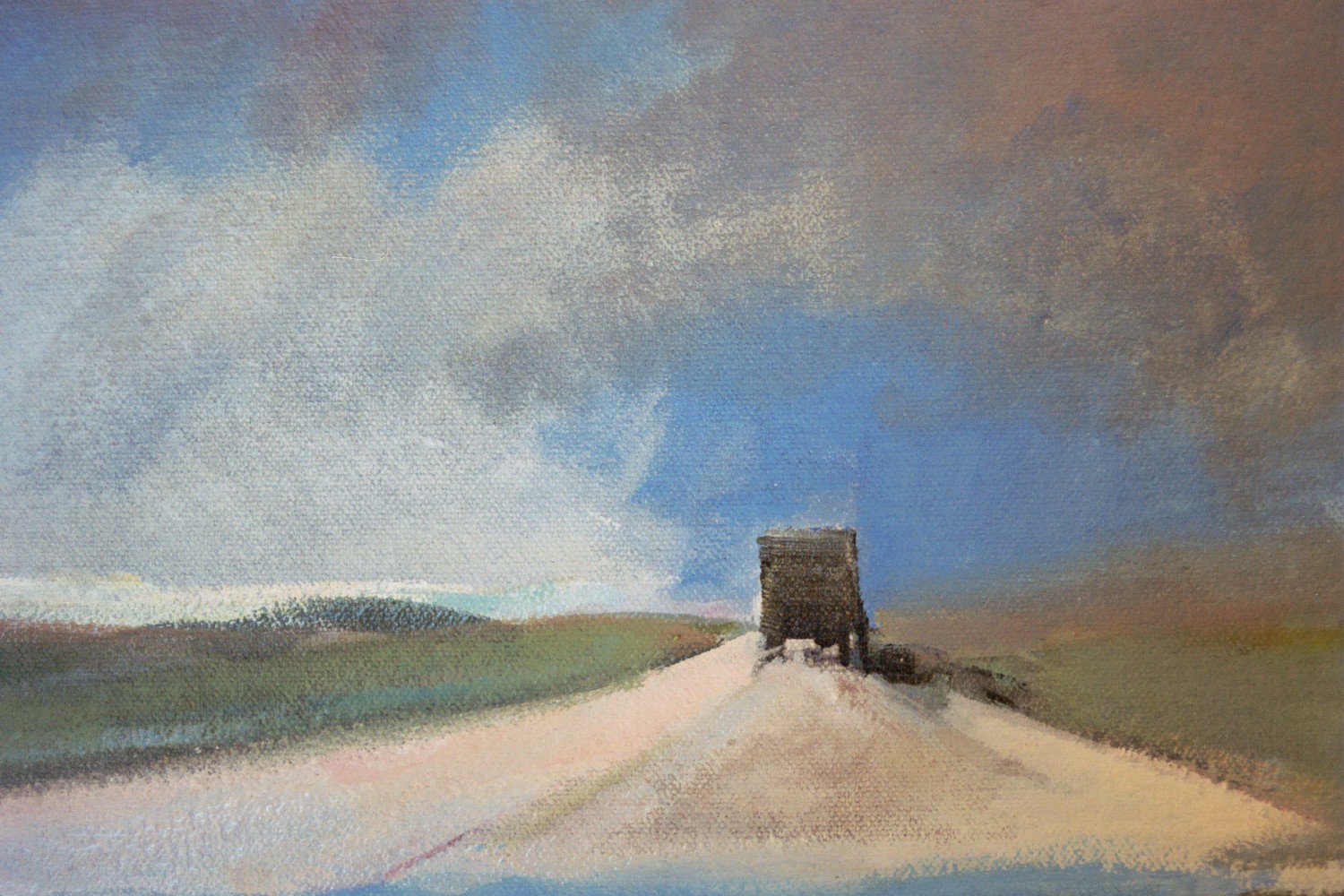 The truck in front of you never takes up much space on your windshield, have you ever noticed? A windshield is a nice size for a canvas. It’s a good place to notice what’s going on with one-point perspective. (You might want to try this when you’re a front-seat passenger, though, rather than when you are driving!)
So- how do you get a view of a ramble all onto one canvas? Not solved yet.
But I can see one big advantage to one-point perspective. If you want the three-dimensional world onto two dimensions, one-point perspective can definitely fit a lot on to one canvas. Except that… most of it is packed into that dot on the horizon line.
 Dunja Pelto Artwork and Essays
Congrats. A beautifully written description of the process. Love the painting; more abstract than most of what I’ve seen of yours.
LikeLike